People ask me how I come up with ideas for designs for knitwear, and I usually brush off the question because the answer is huge!
Usually, a design comes from a situation. I'm going somewhere special and I want something special to wear to the event, or I bought some clothes and want something to go with it.
This kind of situation means I already have been inspired about what I'd like to wear. It also includes a lot of personal biases. For instance, I love pockets! I try to put pockets in everything except mitts, mittens, hats, and cowls. And even then I think about doing it. A pocket that's the right size for a bus pass that's a tap card is perfect for the back of a mitten if you commute by bus.
But it also to extends to styles. For instance, I love cables and Celtic Knots.
And a Celtic Knot is a great thing to put in a spot where there is shaping:
And then, I thought, why can't cables and knots be combined and go in different directions?
I thought some more about what else I could do with them, and realized that they could come off the surface of the knitting and do something.
I don't know if you can see it, but there is a Celtic knot (a Saint John's cross, which is a symbol for happiness), but the bottom of it comes off the surface and threads through some picot holes to form a drawstring at the bottom of the sleeve. The end of the drawstring can be tied into a bow without pulling it tight to form a bell sleeve, or it can be pulled tighter to form a ruffled bottom and a bloused sleeve. You can see the way it works better here:
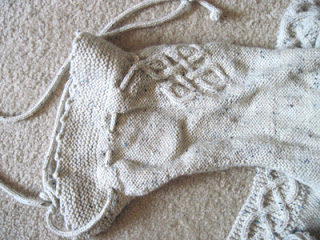
And it can perform other functions, like coming off the surface to form button loops on the front of a sweater.
These photos are all shown before blocking, so they look a little rough.
If I'm fresh out of ideas for myself, I think about a friend and wonder what they'd like to wear. And what colors they'd like, although color is such a big topic that it will have to go in its own post.
Or, I'll see a sweater in a magazine, and think about changing something about it to make it a completely different sweater. But more often, I'll see a sweater and think that a motif on it would be great on a shawl.
Then again, you can think about different knitting or crochet techniques, which is sort of what I did with the cables and Celtic knots. But this can work for anything, like entrelac. Or a trim, like fringe, which I'm beginning to find out can be done a lot of different ways. The more I look at it, the more I think about writing a whole book about fringe and different ways to do it.
Or Mobius. Here's a simple mobius cowl:
Which lead me to think about making a hat with a mobius cuff:
A lot of the knitting I do is inspired by the designing I have done for sewing fabrics, so it's very plain and relies on shape for the design. So they're very simple knitting, but sometimes can look very intricate.
Have you ever wanted to get a tattoo? You can knit whatever tattoo you'd like to get into a sweater! Then you can have it just when you want to wear it, and just take it off to remove it. You can think of it as a "try-out" tattoo, or something that you don't have to commit completely to.
Another thing I've been wanting to do for myself is a lifetime sweater. This would be a plain sweater that has symbols on it of achievements you've had during your lifetime, or things you're interested in, or things you've learned. For me, it could have an entire Viking rune futhark around the bottom, because I'm interested in Viking runes. It might have a spider on the back because I spin. I was thinking of a winged heart on the sleeve because I flew when I was in the Air Force. But that would also look great as wings across the back, and could extend into batwing sleeves. Maybe some other symbol from a movie I worked on. And so forth. Your accomplishments would be different from mine. It could be done either in a single color with raised designs, or in colorwork, whichever you prefer, or fits what you'll be knitting.
Let your mind go, and think "What if?" There are endless ideas out there for you, too! Have fun with it!
Wednesday, March 28, 2018
Monday, June 12, 2017
Learning to Spin on a Navajo Spindle
Someone on Knitter's Paradise sent me a private message that she had bought a Navajo spindle online (which hadn't come yet), and she couldn't find books at the library that were helpful, so she wanted my advice.
After a few huge answers, which didn't even begin to scratch the surface, I am going to post parts of my answers so it might be helpful for everyone.
I think you made a great choice for a spindle. It's a support spindle, so it's easy to spin on. You spin it against your thigh, so your hand is flat, which doesn't stress your hand and even gives it a rest from knitting or crocheting. You can spin any kind of yarn that's spinnable on that. Some novelty yarns, like chenille, aren't spun. You can spin the finest gossamer lace yarn or super bulky yarn and anything in between on it.
What kind of wool roving or sliver did you get to spin on it? If you haven't ordered anything yet, I'd recommend that you start with a nice, commercial Corriedale sliver. Corriedale sheep produce wool with a nice crimp, and it's fairly fine, but is a nice, easy fiber to spin. Ashford has a wonderful selection of colors of Corriedale sliver that's moderately priced. Sliver is pronounced so it rhymes with diver. Sliver is carded, not combed, so it will tend to produce a more fuzzy yarn than top. Top is combed, and is more organized, with more fibers being parallel, rather than jumbled, which is the way carding leaves the fiber. It's called woolen which is less organized, and fuzzier, as opposed to worsted, which is a smoother yarn, but the key here is that it's much easier to spin.
http://jumbukwool.com.au/ashford-craft/ashford-slivers
I chose this link because it shows all the colors available in the fiber. Scroll down from the merino/silk to the next listing. You could choose a natural, undyed color and dye it, or buy two 4 ounce bags, each in a different, but close shade of the same color or something close, like light blue and lavender and ply them together to get 8 ounces of yarn which is enough to actually make something. The beauty of this is that you can buy just 4 ounces to start and then get another 4 once you get started. Look around before you buy. As with anything, you might find a bargain or a sale. You can buy it in individual ounces from some sellers.
Every time you switch to a different fiber, it will handle a little differently, and you're going to have to adapt to each new fiber, so don't be discouraged when you later buy something different, and it doesn't behave like what you learned on.
You are going to start out by doing some spinning. Then we're going to ply it and make some real yarn.
First of all, when you spin yarn, you're going to get something that wants to kink and curl and fight back. That's what happens. That's going to look awful if you release the tension on it, and that's OK if you intend to ply it, which is what we're going to do. It's like stockinet stitch curling. That's just what it does. And we will fix it when we ply. I'm assuming that you probably want to knit or crochet it, and that works best with plied yarn, so we're going to make yarn that's good to knit or crochet with. At least to start. You can make novelty yarn later. Right now, you're just learning to do it.
Oh, and I should mention right now that most of the things spinning books tell you not to do are really OK to do to produce novelty yarns. What they usually mean is not to do it if you want perfectly smooth, even yarn. That's great, but you might want to make novelty yarn, too. Other spinners ask me how I made some of my best yarn, and when I tell them, they say, "Oh, I would never do that!" because some book told them not to.
Continued soon!
After a few huge answers, which didn't even begin to scratch the surface, I am going to post parts of my answers so it might be helpful for everyone.
I think you made a great choice for a spindle. It's a support spindle, so it's easy to spin on. You spin it against your thigh, so your hand is flat, which doesn't stress your hand and even gives it a rest from knitting or crocheting. You can spin any kind of yarn that's spinnable on that. Some novelty yarns, like chenille, aren't spun. You can spin the finest gossamer lace yarn or super bulky yarn and anything in between on it.
What kind of wool roving or sliver did you get to spin on it? If you haven't ordered anything yet, I'd recommend that you start with a nice, commercial Corriedale sliver. Corriedale sheep produce wool with a nice crimp, and it's fairly fine, but is a nice, easy fiber to spin. Ashford has a wonderful selection of colors of Corriedale sliver that's moderately priced. Sliver is pronounced so it rhymes with diver. Sliver is carded, not combed, so it will tend to produce a more fuzzy yarn than top. Top is combed, and is more organized, with more fibers being parallel, rather than jumbled, which is the way carding leaves the fiber. It's called woolen which is less organized, and fuzzier, as opposed to worsted, which is a smoother yarn, but the key here is that it's much easier to spin.
http://jumbukwool.com.au/ashford-craft/ashford-slivers
I chose this link because it shows all the colors available in the fiber. Scroll down from the merino/silk to the next listing. You could choose a natural, undyed color and dye it, or buy two 4 ounce bags, each in a different, but close shade of the same color or something close, like light blue and lavender and ply them together to get 8 ounces of yarn which is enough to actually make something. The beauty of this is that you can buy just 4 ounces to start and then get another 4 once you get started. Look around before you buy. As with anything, you might find a bargain or a sale. You can buy it in individual ounces from some sellers.
Every time you switch to a different fiber, it will handle a little differently, and you're going to have to adapt to each new fiber, so don't be discouraged when you later buy something different, and it doesn't behave like what you learned on.
You are going to start out by doing some spinning. Then we're going to ply it and make some real yarn.
First of all, when you spin yarn, you're going to get something that wants to kink and curl and fight back. That's what happens. That's going to look awful if you release the tension on it, and that's OK if you intend to ply it, which is what we're going to do. It's like stockinet stitch curling. That's just what it does. And we will fix it when we ply. I'm assuming that you probably want to knit or crochet it, and that works best with plied yarn, so we're going to make yarn that's good to knit or crochet with. At least to start. You can make novelty yarn later. Right now, you're just learning to do it.
I'd buy at least 4 ounces to start with. That's what I did. But you'll find that the whole process is mesmerizing and addictive, and you're going to be unhappy when that little bit of yarn gets spun, and you can't keep going. I know I did.
Your sliver might arrive kind of squashed. You can find a spot at the end of the sliver to pull it in half down the length of the sliver. Then pull each section apart lengthwise again. This is probably the easiest way to fluff it up again and make it easy to spin. A lot of your success will come from starting with a nice, fluffy sliver that drafts easily. Plus, if you do this, you'll have less drafting to do.
If you really get into this, you may want to buy cards and card your own wool to make heathered colors from pre-dyed wool or fiber. But for the moment, you need to find out what makes a good carded or combed fiber for spinning. And you want to have something that's a good quality, but still fairly cheap, while being a fiber that can make you proud of the first thing you've spun. The Ashford Corriedale is a great compromise. I'm telling you things like brand names because the names mean I know exactly what I'm telling you to buy is good quality, and I know what I'm recommending and I'm sure you'll get something that's easy to spin and I can tell you how to handle that fiber.
When you have your Navajo spindle and your sliver, you can get started.
Spinning consists of two parts.
Your sliver might arrive kind of squashed. You can find a spot at the end of the sliver to pull it in half down the length of the sliver. Then pull each section apart lengthwise again. This is probably the easiest way to fluff it up again and make it easy to spin. A lot of your success will come from starting with a nice, fluffy sliver that drafts easily. Plus, if you do this, you'll have less drafting to do.
If you really get into this, you may want to buy cards and card your own wool to make heathered colors from pre-dyed wool or fiber. But for the moment, you need to find out what makes a good carded or combed fiber for spinning. And you want to have something that's a good quality, but still fairly cheap, while being a fiber that can make you proud of the first thing you've spun. The Ashford Corriedale is a great compromise. I'm telling you things like brand names because the names mean I know exactly what I'm telling you to buy is good quality, and I know what I'm recommending and I'm sure you'll get something that's easy to spin and I can tell you how to handle that fiber.
When you have your Navajo spindle and your sliver, you can get started.
Spinning consists of two parts.
There's drafting, which is pulling the fibers out until there's about an equal amount of fibers or thickness. This is why pulling your sliver into 4 lengths is good. It tends to pull the fibers apart a bit and let them slide out more evenly when you draft, and it makes the fiber supply thinner so there's less drafting to do.
Then there's twisting, which pulls the fibers together, and that makes it more difficult to draft, and is what holds the yarn together and keeps it from just falling apart. If you get a lump in your yarn while you're making it and don't want it there, stop the spindle and grab the yarn on the side of the lump that's closer to the spindle and untwist it. Pull gently, and the fibers will slide against each other again, and you can pull the lump out. Because you're just starting, I wouldn't worry too much about lumps and unevenness. If it's not really extreme, it will make a great novelty yarn that will make people ooh and ah over.
Oh, and I nearly forgot that there is winding it onto a spindle (in this case) or bobbin to hold the newly spun yarn until you can ply it.
Oh, and I should mention right now that most of the things spinning books tell you not to do are really OK to do to produce novelty yarns. What they usually mean is not to do it if you want perfectly smooth, even yarn. That's great, but you might want to make novelty yarn, too. Other spinners ask me how I made some of my best yarn, and when I tell them, they say, "Oh, I would never do that!" because some book told them not to.
Continued soon!
Sunday, May 24, 2015
The End Is in Sight for Steve Canyon!
A huge load has been lifted off my mind, because the covers for the third Steve Canyon DVD are done!
We thought the cover was done a long time ago, but there turned out to be a few changes. All the last minute changes are finished and it's ready to go to the printer.
It's been a long, hard road for this last little bit of the Steve Canyon saga on DVD, but the end is in sight!
I want to commend John Ellis for his patience and perseverance during what has to be the most awful series of events in DVD-making history. He's suffered through crashed drives that self-destructed, taking months of work with them to the digital grave, the loss of electricity for an extended period of time, personal health problems and enough to crush most people. I want to thank everyone who was patient and supportive while he struggled through this mess.
Items that were the last in existence anywhere turned out to be in terrible condition rather than the pristine state he was promised.
People he'd interviewed have died since he interviewed them.
But it did give him time to find, connect with, and interview people who participated in the original TV show, and add content that wasn't available when he started, or even when he started the last DVD.
It's been what seems like a never-ending marathon, and a labor of love.
I'm happy and proud to have been able to contribute to the whole project by doing the covers for the DVDs and the slipcover. If you haven't seen the slipcover art, check out John's blog at: Steve Canyon on DVD.
And I'm going to treat you to a sample of my work by giving you an advance peek at the covers.
I really like that we finally got a cover that really shows Dean Frederick's face.
I know a lot of you watch things like this for the planes, and I do like to see them, but for me, flying them is much more fun than looking at them. Unfortunately, I never got to fly any of the planes Steve Canyon did, just T-34s.
In this case, I really love that cover. I know one person who's really going to love this cover!
Here's the inside of the cover. The list of episodes is dull, visually, but vital info! And another great shot of Dean Fredericks!
Keep in mind, when you watch the episodes that this project has been done a lot later than the original series. A lot of the material was in really bad condition when John got it, and cleaning it up and making it look good is an amazing job taking thousands upon thousands of hours and so much work by him and him alone!
The photos I was able to get to start with looked terrible, and with all three of the covers and the slipcase, I put in weeks of work. And almost all of the photos were in black and white, and I'm the one who hand colored them.
I need to go out and buy a bottle of champagne so I can celebrate when that last DVD arrives in the mail, and the whole project is officially DONE!
John is now feeling better after some months of debilitating pain, and expects to get a post out soon. The end is in sight!
Have a great Memorial Day weekend! Remember those guys who fly for us as well as all the rest of the guys (and gals) who defend this country!
We thought the cover was done a long time ago, but there turned out to be a few changes. All the last minute changes are finished and it's ready to go to the printer.
It's been a long, hard road for this last little bit of the Steve Canyon saga on DVD, but the end is in sight!
I want to commend John Ellis for his patience and perseverance during what has to be the most awful series of events in DVD-making history. He's suffered through crashed drives that self-destructed, taking months of work with them to the digital grave, the loss of electricity for an extended period of time, personal health problems and enough to crush most people. I want to thank everyone who was patient and supportive while he struggled through this mess.
Items that were the last in existence anywhere turned out to be in terrible condition rather than the pristine state he was promised.
People he'd interviewed have died since he interviewed them.
But it did give him time to find, connect with, and interview people who participated in the original TV show, and add content that wasn't available when he started, or even when he started the last DVD.
It's been what seems like a never-ending marathon, and a labor of love.
I'm happy and proud to have been able to contribute to the whole project by doing the covers for the DVDs and the slipcover. If you haven't seen the slipcover art, check out John's blog at: Steve Canyon on DVD.
And I'm going to treat you to a sample of my work by giving you an advance peek at the covers.
I really like that we finally got a cover that really shows Dean Frederick's face.
I know a lot of you watch things like this for the planes, and I do like to see them, but for me, flying them is much more fun than looking at them. Unfortunately, I never got to fly any of the planes Steve Canyon did, just T-34s.
In this case, I really love that cover. I know one person who's really going to love this cover!
Here's the inside of the cover. The list of episodes is dull, visually, but vital info! And another great shot of Dean Fredericks!
Keep in mind, when you watch the episodes that this project has been done a lot later than the original series. A lot of the material was in really bad condition when John got it, and cleaning it up and making it look good is an amazing job taking thousands upon thousands of hours and so much work by him and him alone!
The photos I was able to get to start with looked terrible, and with all three of the covers and the slipcase, I put in weeks of work. And almost all of the photos were in black and white, and I'm the one who hand colored them.
I need to go out and buy a bottle of champagne so I can celebrate when that last DVD arrives in the mail, and the whole project is officially DONE!
John is now feeling better after some months of debilitating pain, and expects to get a post out soon. The end is in sight!
Have a great Memorial Day weekend! Remember those guys who fly for us as well as all the rest of the guys (and gals) who defend this country!
Thursday, December 5, 2013
SPINNING BASICS: Tools to Spin With: Spindle Spinning Wheels
There are two basic types of spinning wheels: spindle wheels and flyer-and-bobbin wheels (also called treadle wheels).
A spindle wheel is a wheel that has a spindle almost exactly like a support spindle, but it's driven by a wheel.
There are a lot of different kinds of spindle wheels. The first ones invented were in the East and were called Charkas, which is the Sanskrit word for "wheel." They were similar to this kind of a wheel.
There are also small, folding charkas that fold up into a hardback book size and shape (usually called a book charka), and larger versions called briefcase charkas, etc.
The spindle wheels that you'll see most often are called great wheels, walking wheels and wool wheels.
They are all basically a spindle that has support, and that is driven by a wheel that is usually turned by hand, not by a treadle.
This is the kind of wheel that sleeping beauty ran afoul of. Spindle wheels got a lot more use than spindles did, once they were introduced, and they frequently had spindles that were metal. The amount of use that they got, over a period of time, tended to sharpen the tip of the spindle until it was really dangerous. Add that to the fact that sheep go out and play every day in the dirt (you know, the stuff that has a lot of tetanus organisms), and it's no wonder sleeping beauty could get seriously hurt on that wheel!
Wikipedia has a whole collection of photos of different kinds of wheels and lots more information. I'm going to do more articles about treadle wheels, but you can read ahead here.
Great wheels were called that because they have a large wheel. The name walking wheel came from the fact that a spinner would have to stand, and would usually walk to spin a longer thread before she went back to wind it onto the spindle. The name wool wheel comes from the fact that the larger spindle wheels were made to spin wool, and had lower ratios, which was just what was needed to spin wool.
When a spinner refers to ratios in connection with a wheel, it tells you how many twists the wheel adds to the singles being spun for each revolution of the wheel.
Most of the charkas were built with the intention of spinning cotton, so they had higher ratios. To give you a better idea, the bottom ratio for treadle wheels will give you 3-1/2 twists per one revolution of the wheel, where the top end is more like 22:1. But some of the charkas would give you more like 36:1 to really add a lot of twist fast.
With almost every spindle wheel, you'll find a wheel with a drive cord. The drive cord will drive a whorl, and sometimes they have several whorls close together with different diameters so you can make the spindle go faster or slower to suit you by changing which whorl the drive cord is on. Some charkas have an accelerator where the wheel turns a whorl on an axle with another whorl that has a drive cord that drives the whorl on the actual spindle. This is usually called a Minor head, after the gentleman who invented it, and it's a way to get more revolutions out of the spindle for each revolution of the wheel.
Some of the book charkas and similar ones are more complicated because they have extra parts that allow them to fold, but this covers the basics of spindle wheels.
A spindle wheel is a wheel that has a spindle almost exactly like a support spindle, but it's driven by a wheel.
There are a lot of different kinds of spindle wheels. The first ones invented were in the East and were called Charkas, which is the Sanskrit word for "wheel." They were similar to this kind of a wheel.
There are also small, folding charkas that fold up into a hardback book size and shape (usually called a book charka), and larger versions called briefcase charkas, etc.
The spindle wheels that you'll see most often are called great wheels, walking wheels and wool wheels.
They are all basically a spindle that has support, and that is driven by a wheel that is usually turned by hand, not by a treadle.
This is the kind of wheel that sleeping beauty ran afoul of. Spindle wheels got a lot more use than spindles did, once they were introduced, and they frequently had spindles that were metal. The amount of use that they got, over a period of time, tended to sharpen the tip of the spindle until it was really dangerous. Add that to the fact that sheep go out and play every day in the dirt (you know, the stuff that has a lot of tetanus organisms), and it's no wonder sleeping beauty could get seriously hurt on that wheel!
Wikipedia has a whole collection of photos of different kinds of wheels and lots more information. I'm going to do more articles about treadle wheels, but you can read ahead here.
Great wheels were called that because they have a large wheel. The name walking wheel came from the fact that a spinner would have to stand, and would usually walk to spin a longer thread before she went back to wind it onto the spindle. The name wool wheel comes from the fact that the larger spindle wheels were made to spin wool, and had lower ratios, which was just what was needed to spin wool.
When a spinner refers to ratios in connection with a wheel, it tells you how many twists the wheel adds to the singles being spun for each revolution of the wheel.
Most of the charkas were built with the intention of spinning cotton, so they had higher ratios. To give you a better idea, the bottom ratio for treadle wheels will give you 3-1/2 twists per one revolution of the wheel, where the top end is more like 22:1. But some of the charkas would give you more like 36:1 to really add a lot of twist fast.
With almost every spindle wheel, you'll find a wheel with a drive cord. The drive cord will drive a whorl, and sometimes they have several whorls close together with different diameters so you can make the spindle go faster or slower to suit you by changing which whorl the drive cord is on. Some charkas have an accelerator where the wheel turns a whorl on an axle with another whorl that has a drive cord that drives the whorl on the actual spindle. This is usually called a Minor head, after the gentleman who invented it, and it's a way to get more revolutions out of the spindle for each revolution of the wheel.
Some of the book charkas and similar ones are more complicated because they have extra parts that allow them to fold, but this covers the basics of spindle wheels.
Labels:
charkas,
great wheels,
spindle wheels,
walking wheels
Friday, November 22, 2013
SPINNING BASICS: Tools to Spin With: Spindles 2
I have to stop writing these when I'm not really awake (like now).
I intended to write more about spindles and hit send without thinking.
There are a lot of things that affect how fast/slow and how long/short a spindle spins.
As mentioned before, a thinner shaft makes for a quicker spin to start with. It makes sense, because if you snap it between your fingers, for instance, your fingers move at a certain speed, essentially, in a straight line. That movement is translated into a circular spin by rotating the shaft. The narrower the shaft, the further around the circumference you'll move the spindle with the same snap.
The bigger the measurement around the outside of the shaft, the slower you'll move it.
For instance, with a narrow shaft, a snap of the fingers might make the spindle go around twice. If the snap moves what's between your fingers one inch, but the shaft measures a half an inch around, you'll spin it twice. But if it measures a whole inch around, you'll only spin it one full revolution.
Another major factor in spin speed and length of spinning time is the whorl.
A small diameter whorl tends to spin faster than a wide diameter whorl.
But a small diameter whorl will lose it's speed and slow down faster than a wide diameter whorl, which will keep spinning, if more slowly.
You also have to take into account the weight, and where in the whorl it's distributed.
If most of the weight is close to the center, it will tend to spin faster than if most of the weight is toward the outside.
It's a balancing act as far as trading off speed for length of spin. If you're spinning lace yarn, for instance, you'll want a lot of spin, otherwise it'll take forever to get enough twist into the yarn/thread to hold together.
Other factors include the support point for a support spindle. You want the point that the spindle spins on to be as small as possible to generate the least friction. My Tibetan spindle has a brass point on the bottom that's fairly sharp specifically to lower friction when the spindle spins in the bowl.
The other factor is overall weight. The heavier the spindle overall, the more energy it takes to spin it, but the longer it will spin.
If you happen to be talking about a drop spindle, though, the weight of the spindle will make a big difference in the thickness of the yarn you can spin with it. If you try to spin a yarn that's too fine with a drop spindle that's too heavy, the yarn will keep breaking before it will get enough twist in it to be strong enough to hold the spindle's weight. But if your drop spindle is too light or you're trying to spin yarn that is too thick for the spindle, it will tend to make the spindle slow down quickly and stop. If you're not paying attention and try to let it spin, it will eventually (and fairly quickly) stop and begin to spin in the opposite direction, unspinning the yarn and falling.
The overall weight issue is complicated by the fact that, because you keep winding more and more yarn onto the spindle, it keeps increasing it's overall weight the longer you spin. So, if you're using it as a drop spindle, it may be too light when you first start, just right when it's half full, but too heavy when you finally give up and wind the yarn off onto something else to ply it.
This particular information is something that you may find a bit too much at this point, but is something to refer to if you have a problem with a particular spindle in the future.
I intended to write more about spindles and hit send without thinking.
There are a lot of things that affect how fast/slow and how long/short a spindle spins.
As mentioned before, a thinner shaft makes for a quicker spin to start with. It makes sense, because if you snap it between your fingers, for instance, your fingers move at a certain speed, essentially, in a straight line. That movement is translated into a circular spin by rotating the shaft. The narrower the shaft, the further around the circumference you'll move the spindle with the same snap.
The bigger the measurement around the outside of the shaft, the slower you'll move it.
For instance, with a narrow shaft, a snap of the fingers might make the spindle go around twice. If the snap moves what's between your fingers one inch, but the shaft measures a half an inch around, you'll spin it twice. But if it measures a whole inch around, you'll only spin it one full revolution.
Another major factor in spin speed and length of spinning time is the whorl.
A small diameter whorl tends to spin faster than a wide diameter whorl.
But a small diameter whorl will lose it's speed and slow down faster than a wide diameter whorl, which will keep spinning, if more slowly.
You also have to take into account the weight, and where in the whorl it's distributed.
If most of the weight is close to the center, it will tend to spin faster than if most of the weight is toward the outside.
It's a balancing act as far as trading off speed for length of spin. If you're spinning lace yarn, for instance, you'll want a lot of spin, otherwise it'll take forever to get enough twist into the yarn/thread to hold together.
Other factors include the support point for a support spindle. You want the point that the spindle spins on to be as small as possible to generate the least friction. My Tibetan spindle has a brass point on the bottom that's fairly sharp specifically to lower friction when the spindle spins in the bowl.
The other factor is overall weight. The heavier the spindle overall, the more energy it takes to spin it, but the longer it will spin.
If you happen to be talking about a drop spindle, though, the weight of the spindle will make a big difference in the thickness of the yarn you can spin with it. If you try to spin a yarn that's too fine with a drop spindle that's too heavy, the yarn will keep breaking before it will get enough twist in it to be strong enough to hold the spindle's weight. But if your drop spindle is too light or you're trying to spin yarn that is too thick for the spindle, it will tend to make the spindle slow down quickly and stop. If you're not paying attention and try to let it spin, it will eventually (and fairly quickly) stop and begin to spin in the opposite direction, unspinning the yarn and falling.
The overall weight issue is complicated by the fact that, because you keep winding more and more yarn onto the spindle, it keeps increasing it's overall weight the longer you spin. So, if you're using it as a drop spindle, it may be too light when you first start, just right when it's half full, but too heavy when you finally give up and wind the yarn off onto something else to ply it.
This particular information is something that you may find a bit too much at this point, but is something to refer to if you have a problem with a particular spindle in the future.
Labels:
spindle speed,
spindle weight,
spinning
Sunday, November 17, 2013
SPINNING BASICS: Tools to Spin With: Spindles
So far, we've gotten what yarn is, but we're not up to how to make it yet. You'll need tools to make it.
Spinning tools come in two broad categories: spindles and spinning wheels. These come in categories, too. Let's start with spindles and cover wheels in the next post.
Spindles
Spindles come in two broad categories. There are support spindles and drop spindles. Actually, there are a few that can use both or a combination of support and drop. It pays to learn both ways of spinning on a spindle. But we'll simplify to just support and drop spindles.
Support Spindles
As you might guess, support spindles are ones that are supported while they're used. There are many kinds of support spindles, and they're often used with a spinning bowl to keep them from traveling while in use. The bottom of the spindle is usually placed in a bowl, and the spindle spun with a finger snap on the shaft. Most support spindles are used this way.
The fact that the spindle is supported makes it much easier to learn on. You can use a spindle that's too heavy to be used as a drop spindle with the yarn you're trying to make, and it will still work well. And I find it easier to draft and add twist with this kind of a spindle.
A Navajo spindle has the bottom of it placed on the floor or in a bowl (if it tends to skid on the floor) usually on the right side for spinning (Z twist), and the left side for plying (S twist), and spun by rubbing the top of the shaft against your thigh with your hand held flat. Because you're not actually using hand dexterity, this is a good choice for spinners because you're using your arm muscles to provide the spin, not your hand muscles. So, you can give your hands a rest from knitting.
Find out more here.
A low whorl drop spindle can be used as a support spindle if it has a nice, pointed bottom end, and they often do, for versatility. They can be spun in a bigger bowl, or a shallow bowl.
There are many different kinds of support spindles, and many are named for where they became popular, so you'll see them called names like Tibetan, Russian, Andean, and much more. You can search for spindles on sites like Etsy, and if you want a support spindle, you should search for it with those words. If you check Etsy for this, you'll also find a lot of spinning bowls, although you can use any bowl that has kind of a scooped out inside. A bowl that has a flat bottom inside isn't as good for a spinning bowl. You can also find many videos on how to use these different spindles on YouTube. Here's a link for Tibetan spindle spinning: http://www.youtube.com/watch?v=yCjubnwi5Yo
Drop Spindles
Drop spindles are, as you might suspect, given some spin and then dropped. They're harder to master at first because they are the weight they are. If you have a spindle that's too heavy for the yarn you want to spin, it's going to break the yarn before it has enough twist and fall to the ground. If you choose one that's too light, you're going to have a hard time getting it to spin. The twist you're adding with the spindle will be strong enough to resist twisting, and start untwisting instead. You need to watch for both of these conditions and modify the yarn you're making to be compatible with the spindle, or change to a spindle that works better with the kind of yarn you want to spin.
Drop spindles mostly come in either high or low whorl varieties. Either can be snapped in the fingers or you can raise your leg and rub it against your thigh to twirl it before dropping it. I'd recommend the thigh rub, because it will save your hands.
Miscellaneous
There are a few spindles that can be used either way. Low whorl drop spindles can be spun in a bowl. An Akha spindle has a mid whorl, and is usually used supported in the hand, but sometimes, after twist is inserted, it's spun against the thigh and dropped to insert even more twist. See it here.
Turkish spindles are usually considered to be drop spindles, but, as with other low whorl spindles, can be used in a bowl if they have a nice, sharp point at the bottom.
General Info About Spindles
The thin long center part of the spindle is called the shaft. A thin shaft will give you more twist for your effort, but you don't want it so thin that it will break easily.
The wider part of the spindle is usually circular, but could be square, triangular, a straight piece, two straight pieces, a bead or just a wider part of the shaft. It's called a whorl.
Spindles sometimes have a hook at one end to catch the yarn and hold it to make it possible to spin more quickly and easily. Hooks are seen more often on drop spindles. The alternative to a hook is a shaft that narrows to a point. There are pros and cons to each.
Spinning tools come in two broad categories: spindles and spinning wheels. These come in categories, too. Let's start with spindles and cover wheels in the next post.
Spindles
Spindles come in two broad categories. There are support spindles and drop spindles. Actually, there are a few that can use both or a combination of support and drop. It pays to learn both ways of spinning on a spindle. But we'll simplify to just support and drop spindles.
Support Spindles
As you might guess, support spindles are ones that are supported while they're used. There are many kinds of support spindles, and they're often used with a spinning bowl to keep them from traveling while in use. The bottom of the spindle is usually placed in a bowl, and the spindle spun with a finger snap on the shaft. Most support spindles are used this way.
The fact that the spindle is supported makes it much easier to learn on. You can use a spindle that's too heavy to be used as a drop spindle with the yarn you're trying to make, and it will still work well. And I find it easier to draft and add twist with this kind of a spindle.
A Navajo spindle has the bottom of it placed on the floor or in a bowl (if it tends to skid on the floor) usually on the right side for spinning (Z twist), and the left side for plying (S twist), and spun by rubbing the top of the shaft against your thigh with your hand held flat. Because you're not actually using hand dexterity, this is a good choice for spinners because you're using your arm muscles to provide the spin, not your hand muscles. So, you can give your hands a rest from knitting.
Find out more here.
A low whorl drop spindle can be used as a support spindle if it has a nice, pointed bottom end, and they often do, for versatility. They can be spun in a bigger bowl, or a shallow bowl.
There are many different kinds of support spindles, and many are named for where they became popular, so you'll see them called names like Tibetan, Russian, Andean, and much more. You can search for spindles on sites like Etsy, and if you want a support spindle, you should search for it with those words. If you check Etsy for this, you'll also find a lot of spinning bowls, although you can use any bowl that has kind of a scooped out inside. A bowl that has a flat bottom inside isn't as good for a spinning bowl. You can also find many videos on how to use these different spindles on YouTube. Here's a link for Tibetan spindle spinning: http://www.youtube.com/watch?v=yCjubnwi5Yo
Drop Spindles
Drop spindles are, as you might suspect, given some spin and then dropped. They're harder to master at first because they are the weight they are. If you have a spindle that's too heavy for the yarn you want to spin, it's going to break the yarn before it has enough twist and fall to the ground. If you choose one that's too light, you're going to have a hard time getting it to spin. The twist you're adding with the spindle will be strong enough to resist twisting, and start untwisting instead. You need to watch for both of these conditions and modify the yarn you're making to be compatible with the spindle, or change to a spindle that works better with the kind of yarn you want to spin.
Drop spindles mostly come in either high or low whorl varieties. Either can be snapped in the fingers or you can raise your leg and rub it against your thigh to twirl it before dropping it. I'd recommend the thigh rub, because it will save your hands.
Miscellaneous
There are a few spindles that can be used either way. Low whorl drop spindles can be spun in a bowl. An Akha spindle has a mid whorl, and is usually used supported in the hand, but sometimes, after twist is inserted, it's spun against the thigh and dropped to insert even more twist. See it here.
Turkish spindles are usually considered to be drop spindles, but, as with other low whorl spindles, can be used in a bowl if they have a nice, sharp point at the bottom.
General Info About Spindles
The thin long center part of the spindle is called the shaft. A thin shaft will give you more twist for your effort, but you don't want it so thin that it will break easily.
The wider part of the spindle is usually circular, but could be square, triangular, a straight piece, two straight pieces, a bead or just a wider part of the shaft. It's called a whorl.
Spindles sometimes have a hook at one end to catch the yarn and hold it to make it possible to spin more quickly and easily. Hooks are seen more often on drop spindles. The alternative to a hook is a shaft that narrows to a point. There are pros and cons to each.
Labels:
drop spindles,
spindles,
support spindles
Friday, November 15, 2013
Spinning Basics: Twist Direction
You may have noticed in the previous post that I spoke about twisting fibers in one direction to spin them and the opposite direction to ply them.
But that gets awfully confusing. How can you tell which direction is intended? How can you describe it to someone else?
Spinners have an easy way of describing it. They call the spin direction either S or Z.
It's easy to understand this. Hold a piece of yarn up so it's vertical. What you'll probably see first is the ply twist. It either slants from upper left to lower right, which is the direction of the center part of the letter S, so it's ply twist is called S.
If the slant is from upper right to lower left, then the twist is called Z twist because it's in the direction of the center part of the letter Z.
If you're testing a singles or something that you need to know which direction to ply in, you can see the fibers going in these directions and you know to ply in the opposite direction.
If you spin or ply Z on a wheel, the wheel (as you view it when you sit at it) will rotate in a clockwise direction. If you spin or ply Z on a spindle, the spindle will rotate in a clockwise direction when you look down on it from above.
S is just the opposite. The wheel will turn counter clockwise. The spindle will turn counter clockwise when viewed from above.
Yarn is traditionally spun Z and plied S. I've read that nobody knows why, but if you spin with a spindle, are right handed, and spin the spindle with a motion like snapping your fingers with your right hand, you'll get Z spun yarn. So, it's easier for a right handed person to spin Z on a spindle, and I think that's where this tradition all came from.
For most uses, twist direction doesn't matter, but using yarn with opposite twist directions in the same piece can make a visible difference in the finished item. The fibers are aligned in a different direction and reflect the light differently, so it looks different. The yarn can be all the same dye lot, but look like different colors. If you've ever knitted a sweater in flat pieces and sewn in the sleeve, you know the sleeve color probably looks slightly different right where the seam is, just because the yarn is going in a different direction, even if it's all the same yarn. So, it's usually considered good to have all the yarn for a project spun and plied the same way.
So, I think those two things started the convention that yarn is always spun Z and always plied S.
However, as with a lot of things, if you completely understand the rules, you can see when it's useful to break the rules. Understanding the rules and knowing when to break them should be part of the definition of being an artist. People learn the rules and never break them. As an artist, I've broken them all the time when it makes a better finished piece.
You could, possibly, knit a sweater in "color work" by using all the same dye lot fiber, but spinning lots in opposite directions and using them as different colors. This would be very subtle, but noticeable. I haven't tried this but it would be an interesting experiment that would probably work best in medium to light colors.
I have also read some articles on crochet that insist that yarn spun Z and plied S will tend to untwist the plying twist when crochet, but that yarn that's spun S and plied Z will tend to tighten up the plying twist when it's crochet. I don't crochet much, and haven't tried this. You spinners who crochet might want to test the truth of this.
But that gets awfully confusing. How can you tell which direction is intended? How can you describe it to someone else?
Spinners have an easy way of describing it. They call the spin direction either S or Z.
It's easy to understand this. Hold a piece of yarn up so it's vertical. What you'll probably see first is the ply twist. It either slants from upper left to lower right, which is the direction of the center part of the letter S, so it's ply twist is called S.
If the slant is from upper right to lower left, then the twist is called Z twist because it's in the direction of the center part of the letter Z.
If you're testing a singles or something that you need to know which direction to ply in, you can see the fibers going in these directions and you know to ply in the opposite direction.
If you spin or ply Z on a wheel, the wheel (as you view it when you sit at it) will rotate in a clockwise direction. If you spin or ply Z on a spindle, the spindle will rotate in a clockwise direction when you look down on it from above.
S is just the opposite. The wheel will turn counter clockwise. The spindle will turn counter clockwise when viewed from above.
Yarn is traditionally spun Z and plied S. I've read that nobody knows why, but if you spin with a spindle, are right handed, and spin the spindle with a motion like snapping your fingers with your right hand, you'll get Z spun yarn. So, it's easier for a right handed person to spin Z on a spindle, and I think that's where this tradition all came from.
For most uses, twist direction doesn't matter, but using yarn with opposite twist directions in the same piece can make a visible difference in the finished item. The fibers are aligned in a different direction and reflect the light differently, so it looks different. The yarn can be all the same dye lot, but look like different colors. If you've ever knitted a sweater in flat pieces and sewn in the sleeve, you know the sleeve color probably looks slightly different right where the seam is, just because the yarn is going in a different direction, even if it's all the same yarn. So, it's usually considered good to have all the yarn for a project spun and plied the same way.
So, I think those two things started the convention that yarn is always spun Z and always plied S.
However, as with a lot of things, if you completely understand the rules, you can see when it's useful to break the rules. Understanding the rules and knowing when to break them should be part of the definition of being an artist. People learn the rules and never break them. As an artist, I've broken them all the time when it makes a better finished piece.
You could, possibly, knit a sweater in "color work" by using all the same dye lot fiber, but spinning lots in opposite directions and using them as different colors. This would be very subtle, but noticeable. I haven't tried this but it would be an interesting experiment that would probably work best in medium to light colors.
I have also read some articles on crochet that insist that yarn spun Z and plied S will tend to untwist the plying twist when crochet, but that yarn that's spun S and plied Z will tend to tighten up the plying twist when it's crochet. I don't crochet much, and haven't tried this. You spinners who crochet might want to test the truth of this.
Labels:
spinning,
twist direction
Thursday, November 14, 2013
SPINNING BASICS: What Yarn Actually Is
I used to blog all the time, and then I got caught up in a forum for knitters, crocheters, etc. called Knitting Paradise. There was a lot of interest in spinning, and I agreed to do a series of posts for them. The posts were in the Main section of the forum, which is reserved for knitting and crochet because there really wasn't a place for them. Since then, there is a new section for Other Crafts, and I'm trying to get them moved there. In the meantime, and going forward, I'd like all the articles collected in one place, so I'm duplicating them here. Look for more in the future.
Every once in a while, there's a topic on here about spinning, and they always get a lot of attention and rack up a lot of pages of comments. On the latest one, we wanted to start a new section for spinning, but Admin said it would have to be a user administered section, and as such, it would invisible to the user unless you signed up for it.
So, we decided to just start posting things with the word "Spinning" at the beginning of the post to make things clearer, and make posts more visible.
So, this is the first one I'm putting up under that agreement. I'm planning to put up some posts that are just basic info about spinning, and a good place to start for those who know nothing about spinning, and I'm starting them with "SPINNING BASICS" so they'll be easier to find.
The first thing I want to say is a disclaimer. Up until about 10 or 12 years ago, almost all yarn was something you could spin (the notable exception was chenille). Around that time, mills started finding ways of making novelty yarns like fun fur and other kinds of yarn with constructions that are bizarre.
They are excepted from this discussion. Here, I'm discussing the vast majority of commercial yarns and yarns that you can hand spin.
Now that that's out of the way, here we go.
If you take a bunch of loose fibers and grab them at both ends, providing you're not grabbing both ends of the same fibers, you'll find they pull apart easily. The first thing you have to do is find a way of making these fibers longer and making them stay together if you want to make yarn.
If you twist the fibers together tightly enough, the twist makes them compact themselves together into a narrower group. Tightening that up make it harder for the fibers to slip in opposite directions, so adding fiber, little by little in an even stream, and twisting together tightly enough will make a continuous strand that, for all practical purposes, will not pull apart, and you've created the most basic yarn of all: a singles yarn.
This is good, but the twist in the yarn creates a problem. It wants to untwist. At this point, it's what spinners call a "lively yarn." They also call it an unbalanced yarn. It not only tries to untwist, it wants to twist back on itself, kink, and generally fight with you. You can weave with it, but if you try to knit with it, the fabric will bias, and if you, for instance, knit a scarf in stripes, the stripes will be diagonal. You can diminish this quality with blocking (called setting the twist), but it tends to still be there to some extent no matter how hard you try to get rid of it.
If you're spinning yarn and let go of the end, as much of the yarn as isn't fastened down will immediately untwist itself and become fluff again. You have to keep it restrained to keep it from falling apart.
There's another problem, too. A singles yarn is stronger than loose fibers, but it's still not as strong as it could be.
The way to deal with this is plying. If you take two or more singles yarn and twist them together in the opposite direction from the direction they were spun in, you can increase the strength of the yarn tremendously. If you do it properly, and produce a balanced yarn, you can also completely eliminate the tendency of the singles to want to untwist.
If a yarn is unbalanced, for instance, if it has a lot of spinning twist and not much plying twist, or hasn't got much spinning twist and a lot of plying twist, it will act, to some degree, like a singles, and will try to untwist, kink and fight back.
Sometimes, a spinner may do this for a reason, to create a special effect, but usually, it's considered a defect.
What you usually want to create is a balanced yarn, which is one that will lay still and not try to fight back. Sometimes it's hard to tell if you've created a balanced yarn. If you spin something over time, the twist may (to some degree) set itself on the bobbin or spindle. Then, when you ply it, you may be tempted to underply it. The true test of a yarn and it's balance is to wash the finished yarn and let it dry. Then, you'll immediately see if it's balanced. It's a little late then, although it can still be fixed. It's just extra work.
The way to tell for sure if it's balanced is to look at it carefully, and you may need magnification for this. If you're buying magnification, I recommend a linen tester.
To judge how well the yarn is balanced, look at the plied yarn carefully. You'll see the singles twisting around each other, but if you look really carefully, you'll see the individual fibers in the singles. If the yarn is balanced, these fibers will look like they're running parallel with the direction of the yarn. If the singles had a chance to set either on the spindle or bobbin, the yarn may still act lively, but if the individual fibers are straight, when the yarn is washed, you'll see all that liveliness go away.
This is a test that you can apply to commercial yarn, too. Every once in a while, you may notice that you knit something in stockinette, and if you look at the Vs on the right side, you'll see that instead of the nice V you expect, you're getting something that has one leg of the V almost vertical, and the other at a stronger angle than it should. This is because the yarn isn't balanced, and it can change the look of stockinette and fancy stitches, and if it's severe enough, it can make your knitting bias. In other words, if you knit what should be a rectangle, you may actually get a diamond shape. This is the fault of the yarn, not the knitter!
Next time, I'll cover twist direction.
Every once in a while, there's a topic on here about spinning, and they always get a lot of attention and rack up a lot of pages of comments. On the latest one, we wanted to start a new section for spinning, but Admin said it would have to be a user administered section, and as such, it would invisible to the user unless you signed up for it.
So, we decided to just start posting things with the word "Spinning" at the beginning of the post to make things clearer, and make posts more visible.
So, this is the first one I'm putting up under that agreement. I'm planning to put up some posts that are just basic info about spinning, and a good place to start for those who know nothing about spinning, and I'm starting them with "SPINNING BASICS" so they'll be easier to find.
The first thing I want to say is a disclaimer. Up until about 10 or 12 years ago, almost all yarn was something you could spin (the notable exception was chenille). Around that time, mills started finding ways of making novelty yarns like fun fur and other kinds of yarn with constructions that are bizarre.
They are excepted from this discussion. Here, I'm discussing the vast majority of commercial yarns and yarns that you can hand spin.
Now that that's out of the way, here we go.
If you take a bunch of loose fibers and grab them at both ends, providing you're not grabbing both ends of the same fibers, you'll find they pull apart easily. The first thing you have to do is find a way of making these fibers longer and making them stay together if you want to make yarn.
If you twist the fibers together tightly enough, the twist makes them compact themselves together into a narrower group. Tightening that up make it harder for the fibers to slip in opposite directions, so adding fiber, little by little in an even stream, and twisting together tightly enough will make a continuous strand that, for all practical purposes, will not pull apart, and you've created the most basic yarn of all: a singles yarn.
This is good, but the twist in the yarn creates a problem. It wants to untwist. At this point, it's what spinners call a "lively yarn." They also call it an unbalanced yarn. It not only tries to untwist, it wants to twist back on itself, kink, and generally fight with you. You can weave with it, but if you try to knit with it, the fabric will bias, and if you, for instance, knit a scarf in stripes, the stripes will be diagonal. You can diminish this quality with blocking (called setting the twist), but it tends to still be there to some extent no matter how hard you try to get rid of it.
If you're spinning yarn and let go of the end, as much of the yarn as isn't fastened down will immediately untwist itself and become fluff again. You have to keep it restrained to keep it from falling apart.
There's another problem, too. A singles yarn is stronger than loose fibers, but it's still not as strong as it could be.
The way to deal with this is plying. If you take two or more singles yarn and twist them together in the opposite direction from the direction they were spun in, you can increase the strength of the yarn tremendously. If you do it properly, and produce a balanced yarn, you can also completely eliminate the tendency of the singles to want to untwist.
If a yarn is unbalanced, for instance, if it has a lot of spinning twist and not much plying twist, or hasn't got much spinning twist and a lot of plying twist, it will act, to some degree, like a singles, and will try to untwist, kink and fight back.
Sometimes, a spinner may do this for a reason, to create a special effect, but usually, it's considered a defect.
What you usually want to create is a balanced yarn, which is one that will lay still and not try to fight back. Sometimes it's hard to tell if you've created a balanced yarn. If you spin something over time, the twist may (to some degree) set itself on the bobbin or spindle. Then, when you ply it, you may be tempted to underply it. The true test of a yarn and it's balance is to wash the finished yarn and let it dry. Then, you'll immediately see if it's balanced. It's a little late then, although it can still be fixed. It's just extra work.
The way to tell for sure if it's balanced is to look at it carefully, and you may need magnification for this. If you're buying magnification, I recommend a linen tester.
To judge how well the yarn is balanced, look at the plied yarn carefully. You'll see the singles twisting around each other, but if you look really carefully, you'll see the individual fibers in the singles. If the yarn is balanced, these fibers will look like they're running parallel with the direction of the yarn. If the singles had a chance to set either on the spindle or bobbin, the yarn may still act lively, but if the individual fibers are straight, when the yarn is washed, you'll see all that liveliness go away.
This is a test that you can apply to commercial yarn, too. Every once in a while, you may notice that you knit something in stockinette, and if you look at the Vs on the right side, you'll see that instead of the nice V you expect, you're getting something that has one leg of the V almost vertical, and the other at a stronger angle than it should. This is because the yarn isn't balanced, and it can change the look of stockinette and fancy stitches, and if it's severe enough, it can make your knitting bias. In other words, if you knit what should be a rectangle, you may actually get a diamond shape. This is the fault of the yarn, not the knitter!
Next time, I'll cover twist direction.
Thursday, October 11, 2012
Hi, Strangers!
When I mentally gave myself permission to not have to blog every single day, I didn't anticipate that it would take me this long to post a new one.
But a lot of things conspired to make problems for me.
Blogger changed their whole dashboard, etc, and it suddenly didn't work on my desktop computer. I should note that my DT computer is an iMac that's probably at least 15 years old. It has all my workhorse programs on it, but the internet seems to have all upgraded in the space of a week, and that meant that suddenly the whole internet was speaking Greek as far as it was concerned. I can't access the internet at all on it.
I have upgraded to a newer laptop, but it doesn't have all the programs I like and use on it. I still have to get around to loading them up, and I have things that I really have to do that have been distracting me from it, along with my allergies making me to sick to want to do anything all the time.
I want to put up photos in my posts so that it's more interesting, but PhotoShop is on the other computer. I think I'm going to have to investigate iPhoto so I can put up photos here.
But the most important thing is to just write something, so here goes.
Last weekend was the Fall Fiber Fest!
Unfortunately, I didn't get to go.
I don't have a car anymore, and Holly was having a problem with her brakes, so, to make up for not going and buying a special treat, I bought a treat over the internet, in the form of two pair of Signature straight needles.
I had gotten a pair of size nines in seven inch length with a bell cap and stiletto points in the past, and I love them! I did a potato chip scarf with them out of Mary Maxim Mohair Glitter yarn. Don't turn up your nose because it says Mary Maxim. It's very nice yarn! It has some mohair in with the acrylic and it does have some very sparkly fiber in it, too.
The nines are purple, like these, but mine have the bell cap.
The colorway I bought is Seaspray, which has an assortment of pastel colors in it including green, pink, lavender, blue and turquoise.
I enlarged the photo a lot, so it's a little pixilated (OK, a lot), but you can see the colors better. It seems I can put photos up when I swipe them from the internet. I don't think I'll get in trouble for this because it's really free advertising for the yarn.
This is a very fine yarn that you can knit with a larger needle because of the mohair filling in the spaces. It says to use size nine needles, which is what I did, but the result is very open and airy. I would use a smaller needle if I was making a sweater that I wanted either to actually cover, as opposed to display me, or actually wanted it to provide some warmth. But for the scarf, it's perfect!
I started off using the potato chip scarf pattern that's been bouncing around the internet that uses 20 stitches. I found it awfully narrow, and not ruffly enough to suit me, so I changed it to 24 stitches and an extra short row, which made it wider and gave it a lot more ruffle. Pictures to come when I get off my lazy rear end.
Anyway, I wound up with a scarf that looks like it's made of fairy dust!
Now that it's done, I bought some lavender Lion Brand Fun Fur and am making a scarf with it on the same size 9 needles. Unfortunately, I only bought two balls of it, and the length scarf I want will need another ball. I have to get back to the store to get more. It's currently my traveling project. If I'm working on a large project that I don't want to carry around, I usually also work on a smaller, more portable project like a scarf or socks.
So (back to the original point of this before I strayed off into Signature needle rhapsodies), I ordered two more pair of Signature straight needles in 7 inch length, with stiletto points and bell caps in sizes 5 and 2-1/2. Both of them happen to be blue. Here's a photo of blue Signatures, but keep in mind that mine have bell caps.
I also ordered more yarn from Mary Maxim to make a baby blanket for my soon to appear (January) new great grandson. The yarn is called Prism, and it's multicolored (important for the project) and machine wash and dry. I've raised a baby, and I can guarantee that she doesn't want anything that isn't wash and wear.
This is also really enlarged so you can see the color better. They show this made up in a capelet in their catalog, and the blue gets so light in that sample that it's almost an off white, so this sample may or may not be an accurate color sample. Either way, I think it'll be a nice blanket for a baby/little boy,
For the blanket, I'm planning on using my new size 5 needles to work it in domino knitting.
I also bought a book from Amazon that arrived on Tuesday (actually, it arrived on Monday, but the people at the apartment building I live in wouldn't give it to me until Tuesday), called Domino Knitting. I was a little unsure about spending money on it, but now that it's here, I love it!
The blanket will look a lot like the cover of the book, but be knitted in small blocks that, since the yarn is variegated, will look a lot like the cover, but blue. I love the Signature needles! They're like knitting with jewelry!
And we're having a craft class downstairs in less than a half hour, so I'm going to get off the internet and go down there. I'm not really interested in craft lessons, but there are a bunch of nice people and it's fun.
I am going to try to blog more often, even if I don't have any photos. Actually, I don't think I did too bad for not having any photos.
I hope you've been watching Grimm on Fridays and Once Upon a Time on Sundays!
Have a great weekend!
But a lot of things conspired to make problems for me.
Blogger changed their whole dashboard, etc, and it suddenly didn't work on my desktop computer. I should note that my DT computer is an iMac that's probably at least 15 years old. It has all my workhorse programs on it, but the internet seems to have all upgraded in the space of a week, and that meant that suddenly the whole internet was speaking Greek as far as it was concerned. I can't access the internet at all on it.
I have upgraded to a newer laptop, but it doesn't have all the programs I like and use on it. I still have to get around to loading them up, and I have things that I really have to do that have been distracting me from it, along with my allergies making me to sick to want to do anything all the time.
I want to put up photos in my posts so that it's more interesting, but PhotoShop is on the other computer. I think I'm going to have to investigate iPhoto so I can put up photos here.
But the most important thing is to just write something, so here goes.
**************************
Unfortunately, I didn't get to go.
I don't have a car anymore, and Holly was having a problem with her brakes, so, to make up for not going and buying a special treat, I bought a treat over the internet, in the form of two pair of Signature straight needles.
I had gotten a pair of size nines in seven inch length with a bell cap and stiletto points in the past, and I love them! I did a potato chip scarf with them out of Mary Maxim Mohair Glitter yarn. Don't turn up your nose because it says Mary Maxim. It's very nice yarn! It has some mohair in with the acrylic and it does have some very sparkly fiber in it, too.
The nines are purple, like these, but mine have the bell cap.
The colorway I bought is Seaspray, which has an assortment of pastel colors in it including green, pink, lavender, blue and turquoise.
I enlarged the photo a lot, so it's a little pixilated (OK, a lot), but you can see the colors better. It seems I can put photos up when I swipe them from the internet. I don't think I'll get in trouble for this because it's really free advertising for the yarn.
This is a very fine yarn that you can knit with a larger needle because of the mohair filling in the spaces. It says to use size nine needles, which is what I did, but the result is very open and airy. I would use a smaller needle if I was making a sweater that I wanted either to actually cover, as opposed to display me, or actually wanted it to provide some warmth. But for the scarf, it's perfect!
I started off using the potato chip scarf pattern that's been bouncing around the internet that uses 20 stitches. I found it awfully narrow, and not ruffly enough to suit me, so I changed it to 24 stitches and an extra short row, which made it wider and gave it a lot more ruffle. Pictures to come when I get off my lazy rear end.
Anyway, I wound up with a scarf that looks like it's made of fairy dust!
Now that it's done, I bought some lavender Lion Brand Fun Fur and am making a scarf with it on the same size 9 needles. Unfortunately, I only bought two balls of it, and the length scarf I want will need another ball. I have to get back to the store to get more. It's currently my traveling project. If I'm working on a large project that I don't want to carry around, I usually also work on a smaller, more portable project like a scarf or socks.
So (back to the original point of this before I strayed off into Signature needle rhapsodies), I ordered two more pair of Signature straight needles in 7 inch length, with stiletto points and bell caps in sizes 5 and 2-1/2. Both of them happen to be blue. Here's a photo of blue Signatures, but keep in mind that mine have bell caps.
I also ordered more yarn from Mary Maxim to make a baby blanket for my soon to appear (January) new great grandson. The yarn is called Prism, and it's multicolored (important for the project) and machine wash and dry. I've raised a baby, and I can guarantee that she doesn't want anything that isn't wash and wear.
This is also really enlarged so you can see the color better. They show this made up in a capelet in their catalog, and the blue gets so light in that sample that it's almost an off white, so this sample may or may not be an accurate color sample. Either way, I think it'll be a nice blanket for a baby/little boy,
For the blanket, I'm planning on using my new size 5 needles to work it in domino knitting.
I also bought a book from Amazon that arrived on Tuesday (actually, it arrived on Monday, but the people at the apartment building I live in wouldn't give it to me until Tuesday), called Domino Knitting. I was a little unsure about spending money on it, but now that it's here, I love it!
The blanket will look a lot like the cover of the book, but be knitted in small blocks that, since the yarn is variegated, will look a lot like the cover, but blue. I love the Signature needles! They're like knitting with jewelry!
And we're having a craft class downstairs in less than a half hour, so I'm going to get off the internet and go down there. I'm not really interested in craft lessons, but there are a bunch of nice people and it's fun.
I am going to try to blog more often, even if I don't have any photos. Actually, I don't think I did too bad for not having any photos.
I hope you've been watching Grimm on Fridays and Once Upon a Time on Sundays!
Have a great weekend!
Thursday, August 2, 2012
Happy August!
I meant to blog yesterday, but I missed it! So, I'm wishing this for you a little late.
The photo was taken at Lackland AFB, where I was stationed for a couple of months.
I hope it was a happy one! Having been in the Air Force, I have a soft spot for it and flying. Find out more about Air Force Day from the Department of Defense here!
I'm still working on the shawls with the Celtic knots. The one I'm currently almost finished has a knot that's made up of hearts. I really love this one.
If you look at it, there are two hearts with their bottom points touching in the center, and the knot expands into a big, overall heart.
That's made from Knit Picks Tweed in Marine Heather. The color is rich and beautiful, and the photo doesn't do it justice. You can see it better if you click the link. It is a blue that leans toward turquoise, and the heathering makes it look so deep and rich. It's soft, and just a wonderful yarn! I love this yarn!
Well, it's that time of year again. Pennsic is already under weigh, and some of my friends have already gone. For those of you who don't know, Pennsic is one of the biggest events put on yearly by the Society for Creative Anachronism (SCA), and it attracts people from all over the world.
Pennsic started as a war between the Middle Kingdom and the Kingdom of the East, and it features all sorts of battles including a field battle, woods battle, bridge battle, siege, melee, and much more. The different battles accrue points, and points are also added for winning many other kinds of competition, especially in the arts and sciences. There are also classes in the arts and sciences, royal courts, and shopping, shopping, and more shopping! And I'm not even mentioning the large part of the populace who stay up and party all night.
We are still currently in the first week of Pennsic. It will really get going on Saturday, when the majority of attendees will start arriving. More info as it happens!
I need to get some other things done, now, so I'll try to blog more frequently in the future.
Have fun in the meantime!
Tweet
Happy Air Force Day!
The photo was taken at Lackland AFB, where I was stationed for a couple of months.
I hope it was a happy one! Having been in the Air Force, I have a soft spot for it and flying. Find out more about Air Force Day from the Department of Defense here!
****************************
I'm still working on the shawls with the Celtic knots. The one I'm currently almost finished has a knot that's made up of hearts. I really love this one.
If you look at it, there are two hearts with their bottom points touching in the center, and the knot expands into a big, overall heart.
That's made from Knit Picks Tweed in Marine Heather. The color is rich and beautiful, and the photo doesn't do it justice. You can see it better if you click the link. It is a blue that leans toward turquoise, and the heathering makes it look so deep and rich. It's soft, and just a wonderful yarn! I love this yarn!
****************************
I talked to Holly on Sunday, and she's going to drive out here and see me. It's been a little over a year since I've seen her, although we talk on the phone frequently. I'm really looking forward to trying to find a good chair for me that doesn't damage my elbows like my current one does. I really hope we can find it on Sunday, because it I don't find it until later, I'll have to try to get it home by myself, which means a cab, which I don't think will be a good arrangement.
****************************
Well, it's that time of year again. Pennsic is already under weigh, and some of my friends have already gone. For those of you who don't know, Pennsic is one of the biggest events put on yearly by the Society for Creative Anachronism (SCA), and it attracts people from all over the world.
Pennsic started as a war between the Middle Kingdom and the Kingdom of the East, and it features all sorts of battles including a field battle, woods battle, bridge battle, siege, melee, and much more. The different battles accrue points, and points are also added for winning many other kinds of competition, especially in the arts and sciences. There are also classes in the arts and sciences, royal courts, and shopping, shopping, and more shopping! And I'm not even mentioning the large part of the populace who stay up and party all night.
We are still currently in the first week of Pennsic. It will really get going on Saturday, when the majority of attendees will start arriving. More info as it happens!
I need to get some other things done, now, so I'll try to blog more frequently in the future.
Have fun in the meantime!
Tweet
Labels:
Air Force Day,
Celtic heart knot shawl,
Pennsic
Wednesday, July 4, 2012
Happy Independence Day!
I hope you're celebrating in all the traditional ways!
I have a horrible, foreboding feeling that this may be the last year for a while that we're able to celebrate in peace. Hearing some of the things that representatives of our government are saying, it's making me scared that by this time next year, we may be fighting for our independence all over again. We're certainly not going to get any independence if our elected officials have their way. It makes me wonder why we elected them, and then I think back to George W vs. Al Gore, and realize we didn't elect them!
I always loved the United States. That's why I joined the Air Force. But this isn't the country I served, anymore. It's changed beyond all recognition.
****************************
The Saint John's cross shawl is done in it's City Tweed DK incarnation. I'm currently knitting another one in Wool of the Andes sport weight yarn (it must be Solstice Heather, but I don't think I ordered that color). Anyway, it's a new denim blue, very pretty. I was looking for a lighter shade, but they didn't have a lighter heather blue. Anyway, I'll be at or near the middle of the cross before the day is over.
I still have to get the two scarves off to Knit Picks, but it's been so hot out, and going to the post office is an all-day trip, and I've stood in 100 degree (sometimes plus) weather in the sun for more than 2 hours too many times in the past (or below freezing, with lots of wind), waiting for a bus, to do anything buy dread going. I was considering trying to go to one of the other post offices, but I still have to take the bus to get to them, and if I go to the one that's closest to me, I can walk across the street to the yarn store and sit in the air conditioning for a while before I go back to fighting with the buses. Plus, there's something I want to buy there.
On the point of post office closeness, the one that's closest to me is furthest on the bus. The bus gives me a scenic tour of the county before it will take me anywhere I want to go. So, the post office I get to first on the bus isn't the closest one. And neither of the post offices or the Fed Ex office have places that it's convenient or even out of the sun to wait for the bus to get home.
But back to my local yarn shop, Yarn Cloud. They have a Namaste Buddy Case in eggplant, to match my Laguna bag.
Isn't it pretty? And convient to carry very small things, like tapestry needles. It has separate compartments and magnets built in to hold those needles, your scissors, and more. I've been wanting one for a while, and I can't wait.
The photo shows it with cosmetics in it, but it's great for tiny knitting things, too.
Since I don't have one yet, and wanted to show what it looks like, I went to the Namaste site, and discovered that they are adding a new color in their Oh, Snap bags! In August (just in time for my birthday), they're adding eggplant to the colors available!
Don't those look pretty? And useful? I have to check out the prices, but I really like them.
****************************
Well, I have to get going if I want to do the stuff I need to do today!
Have a great Independence Day, a beautiful balance of the week and a fabulous weekend!
Sunday, June 24, 2012
Happy Summer!
It's well and truly Summer, now. The Solstice was last Wednesday? Sometime last week. We've not only passed Memorial Day, which most people regard as the beginning of Summer, but it's now officially Summer by the calendar.
I've been busy with my latest resolution, which is to get one pattern accepted and off to Knit Picks each month. I'm on a push to get the last little bit of the knotted scarf completely finished and in the mail. I should actually be working on it right now.
When I submitted the proposal for this, I knew that I'd have to take photos and I'd need a model, but I had no idea how to find one. Submitting the prop was a leap of faith. I've decided I'm going to do this, and somehow I will get it done, even if I don't know how I'm going to do it right now.
Well, I put up an ad on CraigsList DC, and three young women answered my ad. One of them was exactly what I was looking for. Her name is Samantha, and here are some photos of her and the scarf (which I made in two different weights and in two colors so I could tell which was which).
Since this, and the next project, and most of the ones I want to do have a Celtic flavor, I was hoping for someone with strawberry blond hair and blue eyes. Samantha has green eyes, but really is perfect, and she has a very nice personality. I'm really delighted with her as a model and a possible new friend. She's wearing the worsted weight scarf in Wool of the Andes in Baltic Heather. The color is beautiful! and it looks great on her.
Here's the same scarf in one of Knit Pick's sport weight Wool of the Andes color Haze Heather. Both colors are made from blending different colors of wool before spinning and they are beautiful. If you examine them closely, you can see all the different colors of fibers.
Here's a closer view of the actual braided knot. The quality of this photo isn't too good, because I took it with my tablet, not a good camera. But you can clearly see what the knot looks like.
I plan to finish putting together the layout for it today, and tomorrow, go back over it and proof it and check it for all the things that Knit Picks requires of their patterns. I was going to say it's a long checklist, but it's actually two shorter checklists.
In the meantime, as you may have noticed since I have photos of finished projects, I've been working on my next project for Knit Picks. It's the shawl with the Saint John's cross in the middle, fringe, and a picot bind off on the top edge. I'm only partly done, but most of the cross is finished. I'm partly through the top part of the cross, after the interlacing ring. Here's what the cross looks like and you can see how far I've gotten.
That's being knit in Knit Picks' City Tweed in DK weight, and the yarn is just scrumptious! It feels great on your skin! I'm getting near the finish, but since this is a triangular shawl, knit from the bottom up, and each row gets another stitch added at the beginning of the row, each row is getting longer. There's still a lot of knitting in this! When I knitted the first one, it took me almost an hour and a half to bind it off! It uses a picot bind off, so there's not only a lot of stitches to bind off, but you keep casting on more stitches, which then have to be bound off, too. This shawl just eats up yarn at an amazing rate! It has a garter stitch background, fringe (each strand of fringe uses about 14 inches of yarn!), and the picot bind off, which is very pretty and adds a nice touch, but also really uses up yarn.
I've been reading Diana Gabaldon's Outlander series. These are really good, too.
It's based on the idea that right after World War II, a woman and her husband are taking a second honeymoon in Scotland, and, while collecting some botanical specimens, she walks between the two sides of a cracked standing stone in a henge and is transported 200 years into the past. The first book is Outlander, and it's first-rate!
I got my copy from the library, and hadn't looked for it on Amazon until I looked it up to put a link to it here so you could read a review of it if you wanted, and I'm stunned at the price for a used copy! I may have to buy the whole series for myself.
The second book is Dragonfly in Amber
, followed by Voyager
, and I'm now up to Drums of Autumn
. Actually, I'm almost finished reading it. I'm really loving it, but the library doesn't seem to have the next book or two, just the final one. I'm either going to have to break down and buy the books or give up for the moment. It's probably a better plan to buy these and read at leisure, though. Drums is over a thousand pages, and it's printed in small type, which is why it's taking me a while to get through them. It's a fascinating story, and she makes me care about the characters, but it's a book that walks, as opposed to books like the Harry Potter books or the Twilight series, that just fly!
I plan to at least take a break from the series and switch to another one that I've really loved.
If you haven't met Odd Thomas
, you really should read the books. There's a series by Dean Koontz all about Oddie, whose parents claimed to have intended to call him Todd, but left off the T by accident on his birth certificate application. Odd sees the dead. They don't talk to him, because to Odd, the dead don't seem to be capable of speech that he can hear. Ghosts come to Odd when they've been killed, in an effort to bring their killers to justice. But he sees other supernatural phenomena, too, like the dark, smoke-like creatures that gather preceding major catastrophes to feast on the negative energy. It's always a mystery for him to solve because although he gets clues, nobody can really tell him what happened, or, in some cases, what's about to happen.
There is a whole series of books about Odd, which I have read, and which you can find on Amazon, plus some graphic novels about Odd which I haven't read. The thing that's prompting me to go back and read the series (aside from the fact that I love them so much that I do that from time to time anyway), is that there's a new book in the series (Odd Apocalypse
) coming out at the end of July. I can't wait!
I hope you've been having a wonderful weekend and have a great week coming up!
Tweet
**************************
I've been busy with my latest resolution, which is to get one pattern accepted and off to Knit Picks each month. I'm on a push to get the last little bit of the knotted scarf completely finished and in the mail. I should actually be working on it right now.
When I submitted the proposal for this, I knew that I'd have to take photos and I'd need a model, but I had no idea how to find one. Submitting the prop was a leap of faith. I've decided I'm going to do this, and somehow I will get it done, even if I don't know how I'm going to do it right now.
Well, I put up an ad on CraigsList DC, and three young women answered my ad. One of them was exactly what I was looking for. Her name is Samantha, and here are some photos of her and the scarf (which I made in two different weights and in two colors so I could tell which was which).
Since this, and the next project, and most of the ones I want to do have a Celtic flavor, I was hoping for someone with strawberry blond hair and blue eyes. Samantha has green eyes, but really is perfect, and she has a very nice personality. I'm really delighted with her as a model and a possible new friend. She's wearing the worsted weight scarf in Wool of the Andes in Baltic Heather. The color is beautiful! and it looks great on her.
Here's the same scarf in one of Knit Pick's sport weight Wool of the Andes color Haze Heather. Both colors are made from blending different colors of wool before spinning and they are beautiful. If you examine them closely, you can see all the different colors of fibers.
Here's a closer view of the actual braided knot. The quality of this photo isn't too good, because I took it with my tablet, not a good camera. But you can clearly see what the knot looks like.
I plan to finish putting together the layout for it today, and tomorrow, go back over it and proof it and check it for all the things that Knit Picks requires of their patterns. I was going to say it's a long checklist, but it's actually two shorter checklists.
In the meantime, as you may have noticed since I have photos of finished projects, I've been working on my next project for Knit Picks. It's the shawl with the Saint John's cross in the middle, fringe, and a picot bind off on the top edge. I'm only partly done, but most of the cross is finished. I'm partly through the top part of the cross, after the interlacing ring. Here's what the cross looks like and you can see how far I've gotten.
That's being knit in Knit Picks' City Tweed in DK weight, and the yarn is just scrumptious! It feels great on your skin! I'm getting near the finish, but since this is a triangular shawl, knit from the bottom up, and each row gets another stitch added at the beginning of the row, each row is getting longer. There's still a lot of knitting in this! When I knitted the first one, it took me almost an hour and a half to bind it off! It uses a picot bind off, so there's not only a lot of stitches to bind off, but you keep casting on more stitches, which then have to be bound off, too. This shawl just eats up yarn at an amazing rate! It has a garter stitch background, fringe (each strand of fringe uses about 14 inches of yarn!), and the picot bind off, which is very pretty and adds a nice touch, but also really uses up yarn.
**************************
I've been watching the Jesse Stone movies on Hallmark Movie Channel all day. They're showing them out of order, which is very disappointing of them. There's a new movie at the end of all this (starts at 8 pm here) that premiered on network TV about a month or so ago. They're all very good.I've been reading Diana Gabaldon's Outlander series. These are really good, too.
It's based on the idea that right after World War II, a woman and her husband are taking a second honeymoon in Scotland, and, while collecting some botanical specimens, she walks between the two sides of a cracked standing stone in a henge and is transported 200 years into the past. The first book is Outlander, and it's first-rate!
I got my copy from the library, and hadn't looked for it on Amazon until I looked it up to put a link to it here so you could read a review of it if you wanted, and I'm stunned at the price for a used copy! I may have to buy the whole series for myself.
The second book is Dragonfly in Amber
I plan to at least take a break from the series and switch to another one that I've really loved.
If you haven't met Odd Thomas
There is a whole series of books about Odd, which I have read, and which you can find on Amazon, plus some graphic novels about Odd which I haven't read. The thing that's prompting me to go back and read the series (aside from the fact that I love them so much that I do that from time to time anyway), is that there's a new book in the series (Odd Apocalypse
**************************
Well, I've managed to delay the work that I should be doing by writing this as long as I possibly can, so I guess I'd better get busy and actually do it.I hope you've been having a wonderful weekend and have a great week coming up!
Tweet
Labels:
knotted scarf,
Odd Thomas,
Outlander,
Saint John's cross shawl
Thursday, May 31, 2012
Yarn!
Yesterday, all the yarn from Knit Picks arrived! That's not totally true. The post office delivered it on Tuesday, but because of the apartment building I live in, I couldn't pick it up until Wednesday. There are things I love about this place, but that's not one of them.
Anyway, I picked up a box full of about $100 worth of yarn! Absolutely free! Well, I've agreed to do a lot of work with it, but it won't cost any actual money.
I had requested Wool of the Andes in either Baltic Heather or Marine Tweed, and gave them a choice which they sent. I was secretly hoping to get the tweed, but they sent Baltic Heather.
Here's the Marine Tweed:
When I went to look for what the Marine Tweed looks like, I realized that they're discontinuing the color and it's on sale! That's probably why I didn't get it. So, if you're looking for something like this, Knit Picks is the place to look. There are some other colors of Wool of the Andes Tweed that are on sale. Check it out.
Isn't it pretty, though?
Anyway, the Baltic Heather yarn is just beautiful! If you look at it closely, you can see so many colors in it, but from a distance, it looks more like a tonal color. I'm really pleased with it. . .
It's every bit as beautiful as the photo shows it to be. In real life, it's even more beautiful.
That's the yarn for the scarf.
The shawl is going to be knit in City Tweed DK, in Porpoise.
It's hard to decide to call this blue or grey, but it's truly beautiful. The Wool of the Andes feels good, but this stuff feels more like an angora rabbit!
I'm really looking forward to knitting with this stuff! It's true luxury fiber!
In the meantime, I'm enjoying the Wool of the Andes. It's knitting up so nice. I finished the first short section of the scarf, and have finished most of the section for the woven knot and will try what I think will be an easier way to weave it. I'll be on to the long straight stretch to the second knot later on this evening.
I've been bored to death with all the Spring TV shows that have finished up last week and left a wasteland in their wake.
Tonight, however, I have pizza, some good stuff on TV, and a scarf that is an easy knit, but looks so great that it's a real joy to knit! I'm planning to kick back and just enjoy the whole thing! I'm going to try to rest my elbow at least several times during the evening.
I wish you an evening as fun as mine is going to be!
Anyway, I picked up a box full of about $100 worth of yarn! Absolutely free! Well, I've agreed to do a lot of work with it, but it won't cost any actual money.
I had requested Wool of the Andes in either Baltic Heather or Marine Tweed, and gave them a choice which they sent. I was secretly hoping to get the tweed, but they sent Baltic Heather.
Here's the Marine Tweed:
When I went to look for what the Marine Tweed looks like, I realized that they're discontinuing the color and it's on sale! That's probably why I didn't get it. So, if you're looking for something like this, Knit Picks is the place to look. There are some other colors of Wool of the Andes Tweed that are on sale. Check it out.
Isn't it pretty, though?
Anyway, the Baltic Heather yarn is just beautiful! If you look at it closely, you can see so many colors in it, but from a distance, it looks more like a tonal color. I'm really pleased with it. . .
It's every bit as beautiful as the photo shows it to be. In real life, it's even more beautiful.
That's the yarn for the scarf.
The shawl is going to be knit in City Tweed DK, in Porpoise.
It's hard to decide to call this blue or grey, but it's truly beautiful. The Wool of the Andes feels good, but this stuff feels more like an angora rabbit!
I'm really looking forward to knitting with this stuff! It's true luxury fiber!
In the meantime, I'm enjoying the Wool of the Andes. It's knitting up so nice. I finished the first short section of the scarf, and have finished most of the section for the woven knot and will try what I think will be an easier way to weave it. I'll be on to the long straight stretch to the second knot later on this evening.
I've been bored to death with all the Spring TV shows that have finished up last week and left a wasteland in their wake.
Tonight, however, I have pizza, some good stuff on TV, and a scarf that is an easy knit, but looks so great that it's a real joy to knit! I'm planning to kick back and just enjoy the whole thing! I'm going to try to rest my elbow at least several times during the evening.
I wish you an evening as fun as mine is going to be!
Subscribe to:
Posts (Atom)


